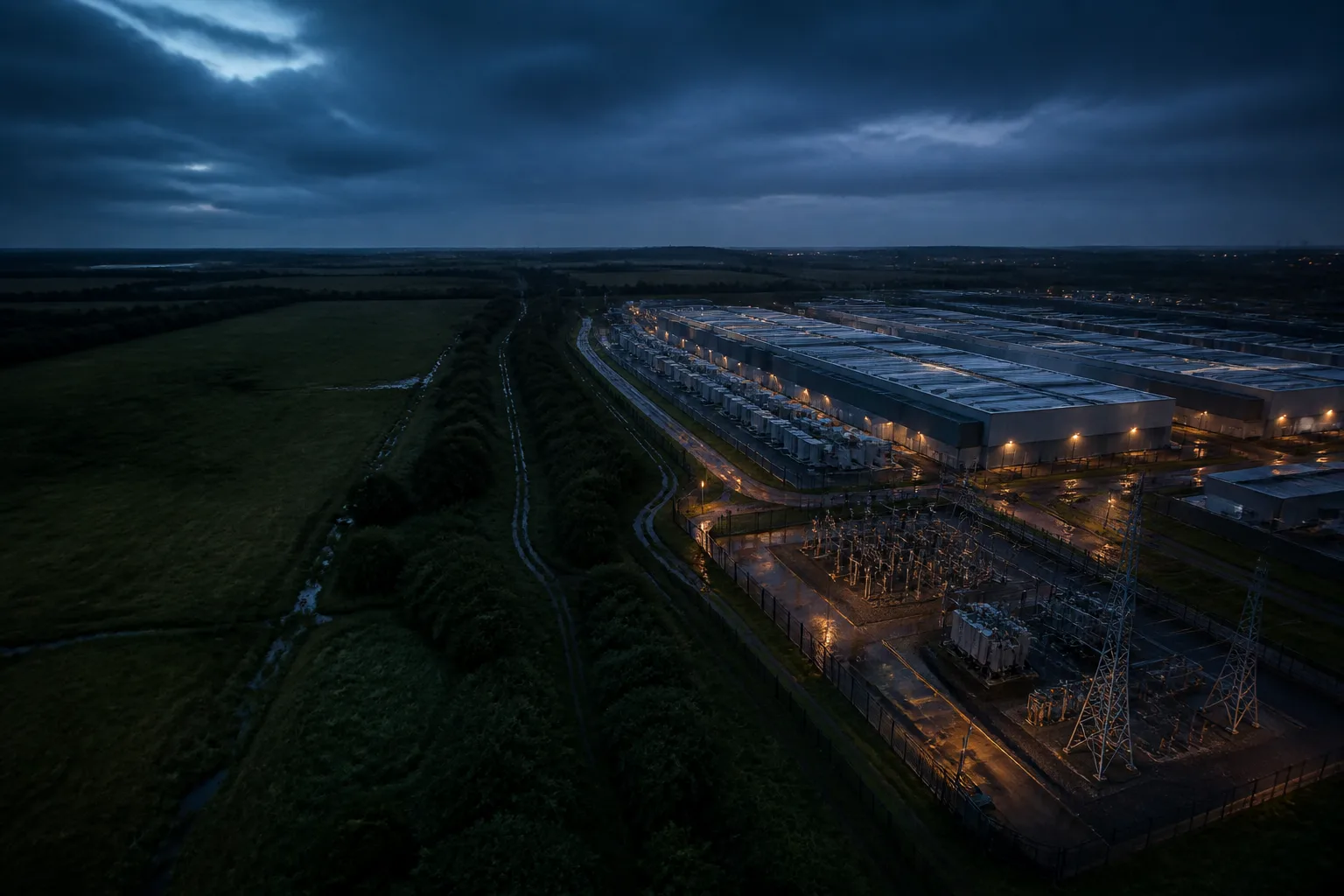
Land sourcing and private introductions
Data Centre Axis reviews stated site requirements against regional utility and property data to identify suitable parcels. When both parties confirm interest based on non-sensitive information, we arrange a managed private introduction.
Commercial negotiations, option agreements, and acquisitions remain solely between the parties. We do not participate in pricing or commercial terms. Technical, environmental, and legal due diligence is scoped separately with independent specialist consultants.
Land categories and site readiness
Land suitable for data centres falls into distinct categories based on utility access, planning status, and site preparation:
- Raw acreage: Undeveloped parcels lacking utility connections, planning consents, and road access. These sites require longer lead times and planning capital before construction can begin.
- Powered land: Parcels with a formal grid connection offer, an existing substation, or an agreed capacity reservation.
- Zoned industrial plots: Land carrying industrial or commercial zoning in local plans. These sites offer planning precedents but often lack secured high-voltage power allocations.
- Development-ready platforms: Parcels with completed earthworks, secure boundaries, access roads, and reserved utility capacity.
Review transport access and hazard separation in our guide to site selection. Landowners can review sales steps in selling land or examine considerations for land for sale.
Developer requirements and intake details
Developers provide baseline site criteria to guide research briefs. Initial enquiries do not require architectural designs, confidential layouts, or corporate ownership details.
A developer brief typically covers:
- Geographic focus: Target regions, proximity to cable landings, or network latency boundaries.
- Power demand: Initial capacity in megawatts, campus scale, and acceptable transmission voltages.
- Site footprint: Usable acreage or hectares, site geometry, and building layout preferences.
- Delivery programme: Target energisation date, interim testing power, and phased milestones.
- Fibre connectivity: Expectations for carrier neutrality, dark fibre access, and diverse routing.
- Cooling approach: Anticipated water needs or closed-loop air cooling preferences.
Submit a site search using our developer site sourcing form. For existing operational halls, visit our colocation directory. For development capital, explore data centre investment.
Landowner submissions and site review
Owners of industrial, brownfield, or agricultural land near high-voltage lines can put forward parcels for review without sharing confidential property documents.
Landowners should provide basic non-sensitive details:
- Boundaries and tenure: Gross area, freehold or leasehold status, and known easements or rights of way.
- Substation proximity: Distance to high-voltage lines or existing utility substations.
- Planning status: Current land use class, local plan allocations, and past planning decisions.
- Site conditions: Historical uses, flood risk classifications, and adjacent environmental designations.
- Access routes: Direct road connections suitable for construction traffic.
Submit parcel details through our asset submission form. Submissions are reviewed privately against developer requirements without public marketing.
Diligence questions and site constraints
Evaluating land for critical infrastructure requires testing key physical, electrical, and planning constraints. Power availability is usually the primary gating factor, but development teams must answer several practical diligence questions:
- Grid connection queue: What is the formal status of the grid offer? Has the utility completed network studies, and does energisation depend on upstream transmission upgrades?
- Capacity terms: Is the power allocation firm, or subject to curtailment during peak network load? Will the site need on-site back-up generation or battery storage?
- Planning and consenting: What consenting route applies? Does the scheme fall under local planning policies or national infrastructure processes?
- Water access: Can local utilities supply peak cooling demand, or does the site require closed-loop dry cooling?
- Fibre diversity: Are there at least two physically separated duct routes to the boundary to avoid single points of failure?
- Ground conditions: Are there contamination liabilities from previous uses? Do ground conditions support heavy transformers and multi-storey halls?
Where projects require specialised engineering or environmental studies, separate scopes can be agreed with independent specialist consultants through advisory services.
Directory research and regional coverage
Data Centre Axis maintains research on operational facilities and development land:
- Australian data centre directory and Australian development assets
- United Kingdom data centre directory and United Kingdom development assets
Selected operating facility index records cover the United States and Canada. Requirements elsewhere are reviewed against available research. Where parameters align, introductions between landowners and developers are facilitated through our private deal network once both parties agree to connect. Principals agree transaction terms directly.